Thursday, February 08, 2007

Still Hurts At Week 8


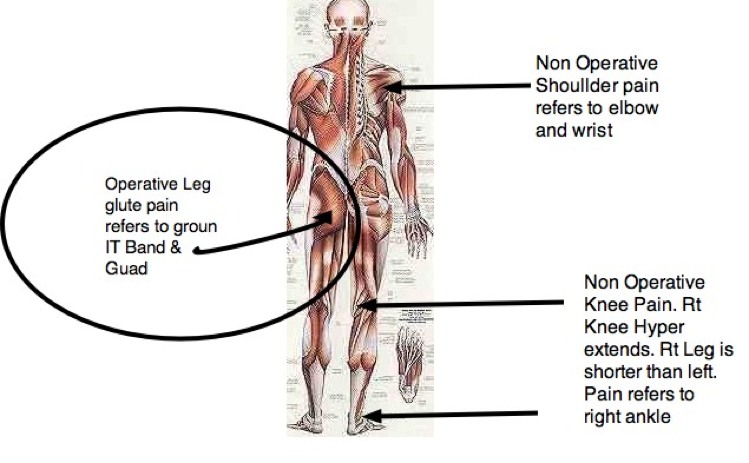
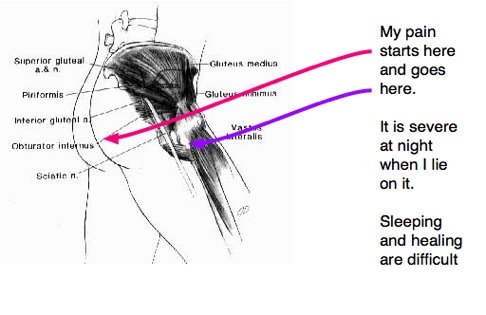
The pain has been most severe at night. I'm unable to sleep more than two hours at a time. The pain shoots from the lower glute, at the bottom of my butt, down the IT band , into the quad muscle and then into the groin. I tried a short term fix, a cortisone shot, didn't work. There was no change in the pain level.


I've had two physiotherapy sessions a week for the last three weeks. There is progress in terms of function and strength. Despite, the pain, I am doing more repetitions of the exercises than when I started, three weeks ago.


Two alternative therapies Active Release and Message are working. The active release is part of the physio regime. performed by my physio Sarah Pearce. Weekly message, is from Leslie Olsen at Healthy Balance, in Sherwood Park. Seven treatments in combination, in the last two weeks, with limited impact is on the pain cycle.

I waited too long to seek alternative therapy. Post Operative pain should diminish over the first four weeks of rehab. Expect to be told pain is normal It isn't. If you aren't sleeping due to post operative pain, in your butt, look into message and active release. Tell your Doctor. You know more about your pain, than he or she ever will.


Active Release Practitioners in Alberta

Monday, January 22, 2007

Sore Groin Sore Glut

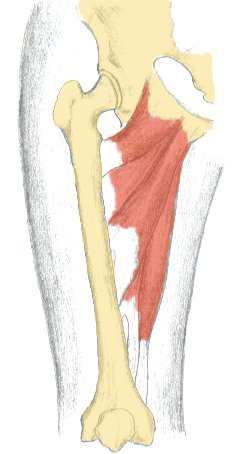
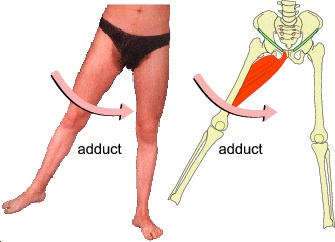
If your butt, groin and thigh muscles hurt like mine, it's likely the adductor muscles need attention.


There's five of them. They extend from the pelvis to the thigh bone and the pelvis to the knee.


The adductors main function is to pull the legs together.


I find the lateral extension difficult to do, however I'm doing it better now than I did six weeks ago.

There are two lateral extensions in the Hip and Knee Clinic booklet. If you are just starting the program I recommend you do those as much as you can prior to surgery.

Wednesday, January 17, 2007

Six Week Check Up

My six-week check-up didn’t start well. My surgeon took expectation to this letter to the editor of the Edmonton Journal.

“ Let's not get carried away with the Hip and Knee Program. The current protocol is myopically focused on systemic, non patient outcomes. Twenty weeks from pre-operation to surgery does not account for 12 weeks of ( post op) patient convalescence. I am four weeks into convalescence. I haven't seen a physiotherapist since I left hospital December 15th. The protocol of the new hip and knee centre should recognize patient outcomes don't end when the hospital door closes behind you.”
I had several issues going into the consultation. It took some time to resolve them.


Five things I learned at my six week consultation.

  • Rehab is a home based patient directed process for 6-8 weeks. (It takes that time for the healing process to take hold)
  • Physiotherapy will not be prescribed during this period.
  • My operative leg is longer, than it used to be, longer than my non operative leg. (This is considered a normal outcome of total hip replacement. It can be mediated with a shoe insert. I over used my non operative leg, in the initial rehab period. My right knee swelled. My right hamstring over stretched. I had more pain than I expected.


  • My operative leg abductor muscles are very weak
  • Physiotherapy starts, January 24th.

I need it

My surgeon and I intend to have lunch to compare notes.

I 'll let you know how we do.

Editorial disclousre, the first draft of this post was written January 17th 2007.It was completed February, 1. The healing process is longer and more painful than anticipated, preempting regular postings. My intention is to create a chronology of this process, by event date, not posting date. Hopefully, it will help future hip replacement patients.

Tuesday, January 09, 2007

SHUT OUT

Twenty weeks to get a new hip, or knee, is the goal of the new Orthopedic Centre planned for Royal Alexandria Hospital, in Edmonton. The Edmonton Journal has editorially embraced the protocol.

(Note: the link may not be live, as Journal does not 'permalink' its’ stories)

Prematurely, I say! I got my new hip in 12 weeks. That is impressive. I am quite pleased; I got in and out that quickly.

There is a problem. The current program is, myopically, focused, on the front end of the process. Twenty weeks from pre-operation to surgery is fine. Then what? The surgeon is done. The patient is not.

Capital Health, may want to talk to some patients. Patient feedback could prove enlightening. Six hundred orthopedic surgeries, a month, are performed, at the Misericordia and the Royal Alexandria hospitals. That is a massive database of patient experience begging to be tapped!


Hip Flex 24 hours after sugergy

Here is a summary of my post operation experience. Support from the Hip and Knee Clinic is sparse. My two-week post operation appointment was a perfunctory, fifteen-minute, visit to remove stitches. I expected a physiotherapy assessment of my progress, then.

I entered the program active, healthy and determined to shorten the rehab cycle, as much as possible. My pre operation preparation has morphed into a self administered, home based, convalescence, bereft of professional guidance. Program sponsored physiotherapy has been denied. I will launch my own post operation exercise plan, shortly. Watch for it.


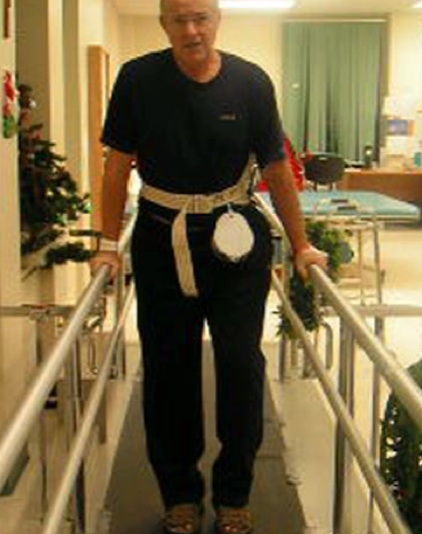
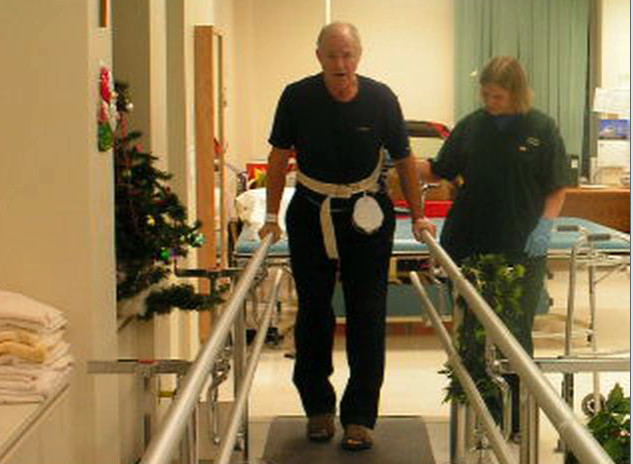
Rail Walking 24 Hours after Surgery

Contrary to my current experience, all orthopedic patients need a professionally designed, personally managed, four week, postoperative rehab program. It should include; a progressive exercise plan, physiotherapy, and a dietary advice, recipes even!

Eating the right food, in appropriate portions, provides the energy to heal. I found it hard to eat, for two weeks. It took that long for the operational drugs to depart my system.

There's an important soical interaction component to convalescence. It is acceptable to be shut in, for two weeks. After that, there's a keen desire to 'get out' and socialize. Social interaction is a panacea a key element in the healing process.

The proposed new Hip and Knee Centre could be just the place to facilitate post operation interaction. It could become a 'patient experience ' laboratory. Information gathered could be catalogued and "paid forward". Use patient wisdom to benefit patients. That will only happen when "convalescence" is recognized as a key component of the process. Currently it isn't!

What is your experience? Let's talk.

Thursday, January 04, 2007

24 HOURS POST OP

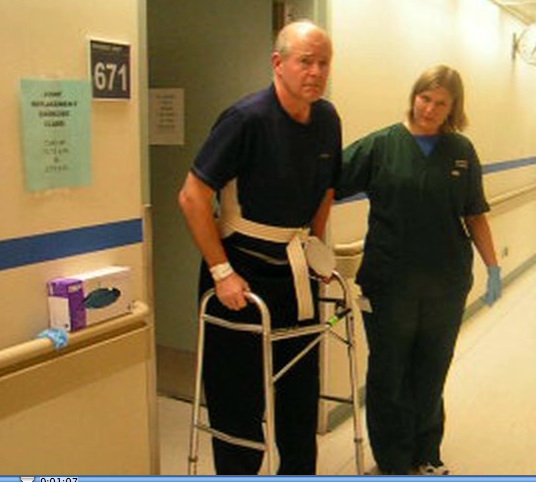
This is day 22 of recovery. It is proceeding well. Here's a clip from physiotherapy, 24 hours after surgery. Thanks to therapist Sherry Rioux for helping me through the exercises.

Wednesday, December 27, 2006

14 DAYS OF RECOVERY


It's day 14 today. Starting to feel better. That's Good. The worst day was day 4. It wasn't the hip. It felt sore. That was expected.


It was the rest of me, reacting to various drugs and hospital therapy. Specifically, I was extremely nasuated. Sought help from my "GP", who made a home vist. That's pretty special stuff. The diagnosis was mild sinus infection, swollen glands. plus a digestive system reaction to medications.

The solution, part his, part mine. I took enzymes and acidophlius for the digestive system. Backed off the pain killers. Reduced the dosage in half. Drank a 'gallon' of fluids, daily, water, plus pop, and juice with sugar, in it. Don't usually drink much of the latter, however all of the above worked. It took a couple of days though.

Is is crtical to have your GP, availabe to you, post operation. Don't botther calling the Hip and Knee Clinic, on medical issues. Deal directly with your GP.

Do all that you can to feel well. For me the objective is to shortern the incapacity stage, as much as possible.
Feeling well is best way I know to do that.

Rehab session 24 hours after surgery

Wednesday, December 20, 2006

RECOVERYING

Just about now 7 days ago I was 'in theatre' for hip replacement. So far, recovery is going well. Standing up typing this post, with a modicum of weight on the new hip. There's been some moments, and no doubt there'll be more, however , it's good to be home, recovering. Stay tuned for some patient perspective , "wisdom" from this crowd of one.


Guiding Hand from Therapist Sherry Rioux 24 hours after surgery

Wednesday, December 13, 2006

Three Tips to Recover from Hip Surgery

Jan Remier is a fomrer Mayor of Edmonton, Alberta, and proud user of a 'bionic' hip. She's had hip replacement surgery. 

Her advice.  Listen to your body. Rehab with professional supervision and do what the phyisotherapist says.

We'll be able to compare notes real soon !


Monday, December 11, 2006

Donating My Hip Bone

Remember the song hip bone?


Prety good


... not it!


This one. althought not a great rendition. I expected to find more. I did learn it's a Negro Spiritual. I just remember it as a fun tune.

Well my hip bone is causing me grief. When it comes out, I've decided to let some one else have a go with it. The Comprehehnsive Tissue Centre, at the University of Alberta, is the agency that goes around chasing for bones.

That's a little hyerpobyle. They ask you to donate. Ninety percent of the folks approached do. That's impressive. They use the 'old bone' for hip, and spinal cord surgeries. Here's a link to the Centre. It's a little dated , however, you'll understand what they do. Expect to hear from these folks, if you're getting a joint makeover.

I'll trust that mine old bone makes a little better connection.


Friday, December 08, 2006

Signed the Contract

There's quite a process involved in acquiring a new body part. It's not a decision to be taken lightly.

Eighteen months ago, here in Alberta, the provincial government created a pilot project for hip and knee replacement surgery. The goal was to create a platform of specialists to deliver joint replacements more efficiently.

It's now called the Bone and Joint Clinic. I signed my contract today. We've all got roles and responsibilities.

If anyone wants to share their experience, I'd love to hear your story, or any tips you might have on the recovery side. Anything to ease my pain is really appreciated!


Learn how the pilot project has morphed into a fully integrated program, here.

Tuesday, December 05, 2006

Not Taking It Anymore!

The Pain that is. In my Butt, left gluteus maximus to be exact. Maybe more info than you need. I've had it for some time, 8 years. Tried just about every thing I know to lose the pain.

Read Back Pain Books. Tried herbs, supplements, accupuncture, message, phisotherpay and yoga. Changed my diet. Rolled the dice on the Egoscue Method. There is merit in all the therapies I tried . They work to some extent, not enough, just can't shake the pain.Gave the alternatives a good shot.

I'm losing capacity to do things, like walk the dog, I don't sleep well. Don't work as well as I know I can. Not all that enthuisased about give up a body part, however, on December 13th, will get a new hip. Stay tuned intend to document the process. It's been around for a while.


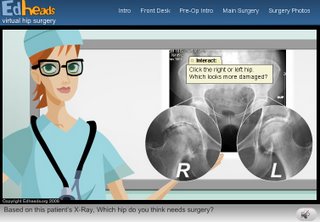
Click here or on the picture to see a 'virtual rendition' of the process

Tuesday, November 21, 2006

Biogen Intersitial

This video was key element in an awareness program for Multiple Sclerosis therapy

Wednesday, May 17, 2006

Snooze To Win


There are no coincidences, right? Two New York Times' pieces caught my eye. One debunking the myth that lactic acid causes muscles fatique. Unfortunatley, it took a hundred years for the establishment to recognize the old 'science' was wrong. Begs the question, how many other old theories need to be scrapped?

The coincicdences, We can train the brain, to let it all go;   imagine learning to sleep! A  little
aerboic excerise,  6 hours before hitting the pillow, creates muscle
fatique, so we can let it all go!  Ah the simplicity of it all.You can . Just in case you, perhaps like me, might be having a problem  with quality shut eye time.


Wednesday, March 22, 2006

Dear Iris--Ease My Pain

Dear Erudite Editor, Sherwood Park News please pass this on to the Minister of Health.

Hello Iris:

I went to see your pal Curt Vos, the other day. He's fine, me not so much. I've this pain in my butt. It goes into my back, my legs and is messing up my kness. It really is annoying. So am I, when I have it. That's probably more detail than you need. Perspective is important though!

So Curt books me an MRI to get to the bottom, so to speak, of all of this. One problem, I can't get it till July 26th. It'll be six months before, I'm on the road to recovery. Time is scare. Function is pretty important, with a finite and declining number of days left, on the planet.

I know you're up to your butt, in Third Way dilberations, so I don't want to take up much of your time. However, as a representative "underwriter" of the current government supplied health care insurance system. I ('we') pay for it through taxes, premiums, and out of pocket for delisted services or alternative therapies not covered, at all.

Why does it take 4 months to get an MRI in the system?

Why can't I use my 'public system' insurance to pay for a MRI, at a private clinic? "They" tell me I can get an MRI there, in two days.

How much does an MRI cost, in the public system?

How will the third way shortern wait times? Reduce costs to me? Increase benefits to me (us)?

How will de listing services, declaring hip and knees as non essential, benefit those with hips knees, and other things that need to be fixed?

How does de listing benefit anyone? In 2005 Alberta Health dropped physiotherapy coverage from 6 to 4 visits. Iris, Why did you do that? Who benefited from that?

What's the benefit in third party Health Insurance? As I see it, subject to clarification of course, I'll pay a premium to a private insurance company, 'they'll' create a deductible, and "they'll" either de list me, or increase my premium when and if I use the insurance, just like the automobile insurance guys do.

Iris, I look forward to discussing this. I trust the Erudite Editor and August Publisher of this weekly journal will be happy to accommodate your response.

Regards Bruce Winter

PS
Friends of Medicare, and anyone who needs something fixed and can't get it, feel free to join in this discussion, here, or at wwww.selfheath.blogspot.com

Monday, August 22, 2005

School Days Stress Reliever

In the wanning of summer and falling ahead, it's the time of year when resolutions are revisited. School starts, routines bump up to accommodate an array of activities, not the least of which is keeping active. Here's an easily incorporated exercise approach via LifeHacker For more concentrated resource in getting rid of the stress around clutter try Get Organized Now .

Wednesday, August 03, 2005

TECHNOLO-GEE

How do they do that, is the medial question of the day. Check this out.


This is a heart monitoring pill It's being used by the NFL to monitor players, during training camp, in the wake of a couple of fatalities. It is rather amazing, however scary too. Imagine the dark side every pill contains a monitoring device hmmm. It's now possible. Thinking a little further, this technology could go along way to resolving the mystery around herbal therapies and what they do or don't' do. At the same time Vioxx might not make it. However no doubt someone can figure out how to 'tweak' the monitor.

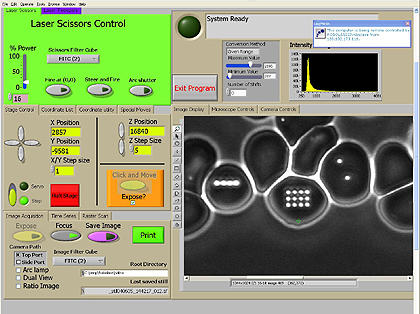
And this is an interface for a laser surgery procedure that can be done and has been done over the Internet.


"In an effort to combine sophisticated laser and Internet technologies, scientists in Australia have successfully performed laser surgery and “optical trapping” in a Southern California laboratory via the Internet.

...In a proof-of-principle series of experiments, the scientists from UC Irvine, UC San Diego and the University of Queensland employed RoboLase to produce surgical holes in a distinct pattern of less than one micron in diameter (1/1000th of a millimeter) in single cells"

Wednesday, July 27, 2005

Waiting List For Herbs

Macleans reports Canada Health Food Directorate has approved 522 of 8180 applications for certification since its inception 2 years ago. All alternative health care products must be licensed by June 2006. There are 30,000 applications in the pipeline.

How do you spell boondoggle? The Health Food Directorate, arbitrarily created by Health Canada monitors the alternative medicine industry. It creates and applies standards similar to those applied to drugs, manufactured from synthetically created chemicals.

Alternative products are not drugs. They are food, plants, or minerals, which have medicinal properties established by practice as opposed to patent.

"Edmonton-based CV Technologies Inc. has a hit with its COLD-fX capsules, made from an extract of chemicals found in North American ginseng. ... For a new natural product like COLD-fX, scientific support is required to show that it does what it's supposed to and is safe to use -- similar to what's demanded for the approval of non-natural drugs and prescription medicines. "

Ginseng is not a chemical. Blending natural ingredients does not make them chemicals.

Compare alternative product policy regulation to this Health Canada advisory . Regulations that create waiting lists and statutory bias are impediments to good health.

Friday, July 15, 2005

Knee TV - update

A couple of clarifications are required from yesterday's Knee TV post. Dale Alton, from AMMS, says the extremity MRI is focused on foot- ankle-knee- hand- wrist and elbow. Also, internet distribution of the images will come via local internet providers, not Alberta Teleheath.


"The term Telehealth is used to describe the delivery of health services, educational programs, or collaboration in research using interactive video, audio, and computer technologies. It allows instantaneous consultation, physical examination, study of x-rays and laboratory findings, supervision of treatment or educational discussions among participants in diverse locations." Alberta Telehealth

Thursday, July 14, 2005

Joint TV

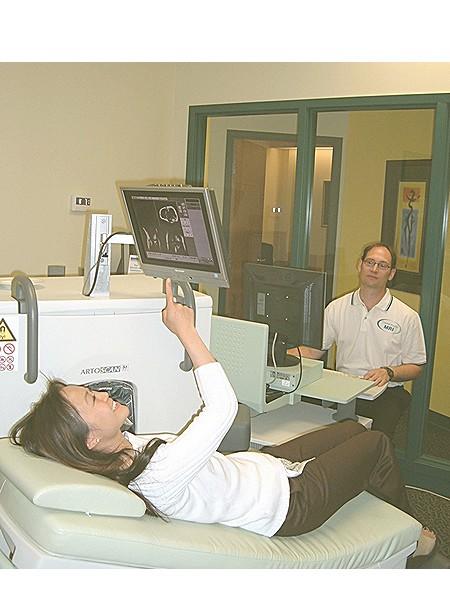
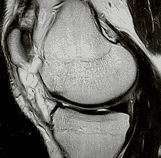
Imagine, 'Knee TV' watching your own MRI, with instant commentary, from a radiologist 300 kilometers away


Knee TV' isn't going to generate 'Survivor' type ratings. However, if you've got a 'joint' or some other extremity, in need of repair, there's a leading edge Alberta solution designed to get you back in the game, quickly.Alberta public policy, in health care and communication, has intersected two image technologies-- digital image distribution and medical imaging.

The health care policy is Alberta's third way. Internet distribution comes via Alberta Telehealth Consider it a heath care dividend, for your portion of the $400 million invested in Alberta Supernet. The medical imaging technology comes from Advanced Medical Mobile Services, an Edmonton based medical imaging company.

AMMS is testing its' extremity MRI machine, at the NorMed Rehab centre, in Sherwood Park. Extremity MRI technology focuses on body parts: knees, shoulders, elbows, ankles.


The service isn't licensed yet. Capital Health is sorting out some issues. When it is, here's how you'll be able to use it. You'll need a medical referral. Your doctor or physiotherapist can provide that. Once you have it, you'll be able to book an appointment directly, or through Alberta Health. The direct service will be available on demand. It costs $395 for a single joint MRI.

"This will change physiotherapy procedures", says Audrey Bjornstadt, owner of NorMed Rehab. Currently, the first couple of sessions of physiotherapy are typically assessment and program development. " With this, we'll be able to condense rehab time", Bjornstadt says.

Imagine, what "Knee TV" may do for your health and well being. Looks good to me.

Sunday, June 12, 2005

Supreme Court Champions Choice for Medical Care

"Access to a waiting list is not access to health care."

That is the key message from the Supreme Court's ruling this week.

The duplicity of Canada's (non) Universal health care system has been exposed. Not only is there private service delivery in the current system, there is privileged service too. Mindelle Jacobs reported there are four medical care tiers not two.

Monopolies do not foster innovation. They limit choice and charge high prices. Canadians have been duped. Government measures it success by how much of your money it spends. Then turns around and restricts access to what you can receive from so called universal medical care coverage by de-listing or creating approved services lists. On top of that, it creates criteria for clinically approved waiting periods, entrenching wait lists as opposed to eliminating them. Just a few weeks ago health Canada said it was spending $15 million to determine what is acceptable waiting time.

There is no acceptable waiting time. There is no need for it. Waiting list were created by politicians for their benefit. The next election is shaping up as more than just a referendum on political integrity it will determine the future of your accesss to medical care.